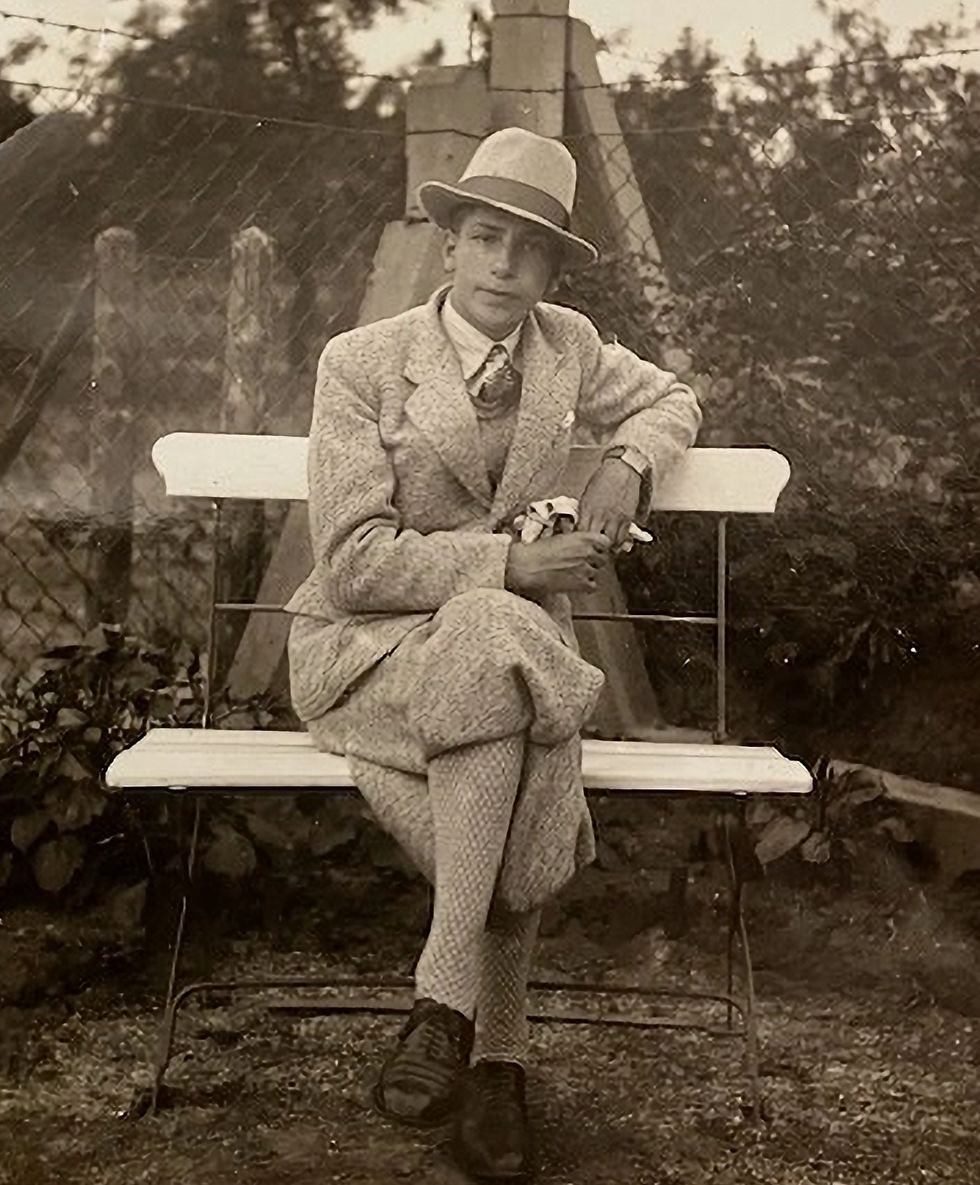
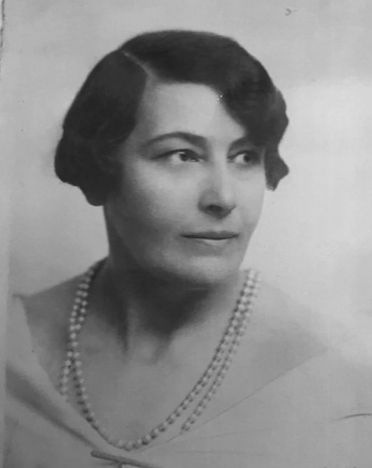
Ehrlich Family
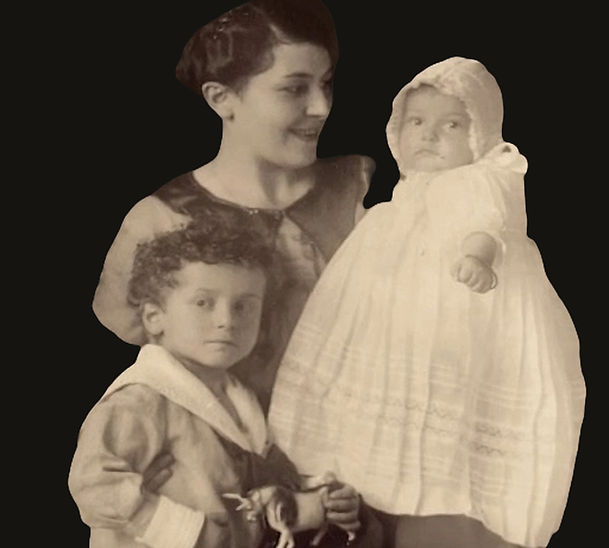
Anna, Karl, and Hilde Ehrlich (1918)
Scroll down past story for more pictures.
Submitted by Jerry Ehrlich, grandson of Hermann & Anna Ehrlich, son of Carl (Karl) Ehrlich
The Ehrlichs are originally from the town of Romhild in Thuringer, about 30 miles from Coburg. The Ehrlichs were the first Jewish family to settle in Römhild in the mid to late 18th Century. My great grandfather, Karl Ehrlich, born in 1849 (in Romhild), and his wife, Clara (née Sander), who were married in 1871, raised eight (8) children in Römhild between the mid 1870s and late 1880s, including my grandfather, Hermann, born in 1882.
In 1896, Karl and Clara moved his family to Coburg where Karl set up a hat and cap factory with Hermann, and Hermann’s brother, Sally. The Ehrlich home and factory was located at what was Zinkenwehr 10 (now known as Sally Ehrlichstrasse 10) in Coburg. Karl died in Coburg in 1906 and Clara died in 1924.
My grandmother, Anna (née Sichel), was born in Veitsocheim in 1889 (near Wurzburg), which, at the time was a farming village. The Sichels trace their family tree in Germany to the late 18th Century. She moved to Coburg and married my grandfather, Hermann in 1914. After his marriage to Anna, Hermann and Anna as well as Clara and Sally, continued to reside in the Ehrlich residence. My father, Carl (née Karl) Ehrlich was born on June 20, 2015. My grandfather and his brothers served in World War I; and his brothers, served in WWI; and his brother, Julius, was killed in the War. After WWI, my Aunt Hildegard (Hilde) Reinstein was born in 1918.
After their father died, Hermann and Sally continued to operate the family men’s hat factory in which my father worked as a child and after he graduated from the Casimirianum Gymnasium. My father played Tennis, Soccer and was an avid Sculler in Gymnasium.
Prior to the advent of National Socialism, the Ehrlichs lived a prosperous, middle class lifestyle in Coburg and helped needy Coburgers in the early 20s.
Unfortunately, once the National Socialists took control of Coburg, my father’s friends turned on him and he was ostracized. He had wanted to attend University; but these dreams never came about as a result of Nazi persecution. In 1935, at age 20, my father was selected to participate in the German Maccabiah Team which participated in the Second Maccabiah in then British ruled Palestine.
Prior to that time, my father and his family sought to leave Germany for South Africa in 1933; but were refused to permission to emigrate. The United States put my father, his parents and sister on a waiting list. In 1938, Carl emigrated to the United States. His sister, Hilde had moved to England. Hermann and Sally were arrested in 1938; but Hermann and Anna were able to make it to England in 1939 (and ultimately, to the United States later that year); but only after Anna agreed to sign over the family home and business to the Nazi regime. Sally Ehrlich remained in Coburg; and was sent to a Concentration Camp where he was killed in 1942. The remaining siblings of Hermann also died in the Holocaust. A number of Anna’s siblings, nephews and nieces were able to emigrate to South Africa, England and the United States.
My father and his family took up residence in Camden, New Jersey, where my father worked in a hat factory as a supervisor. My grandfather delivered eggs and my grandmother, learned to sew and became a seamstress. This was a radical change from the prosperous middle class lifestyle my father and his family enjoyed in Coburg; but they were alive and free.
In 1943, my father enlisted in the United States Army. Since he was bilingual, he was plucked from Basic Training and transferred to Camp Ritchie in Maryland and became a “Ritchie Boy”. The U.S. Army decided that German and Austrian Jewish young men could best serve the War Effort by becoming Military Intelligence Officers and NCOs. My father was a T-3 (equivalent to a Staff Sergeant); and, interrogated German POWs and participated in other classified activities. He became a naturalized citizen in 1943. After the Allied Victory, Carl was sent to Coburg to be part of the Allied Military Government as part of the de-Nazification program to root out Nazis. He insisted that the town rename a portion the street on which the Ehrlich home and factory stood in memory of his Uncle Sally and made sure a plaque was erected on the home. The town renamed the street Sally-Ehrlichstrasse in 1946.
After he was demobilized, Carl returned to Camden, where his parents and sister (and her husband, Alfred Reinstein) lived. Hermann and Anna purchased a row home in Camden. Carl became a Manufacturer’s Representative and Salesman. He met and married, my mother, Sybil Frank Ehrlich, another German Jew whose family had moved from Germany to Holland in 1933; but were trapped in Holland when the Germans invaded in 1940; and lived underground in The Hague. My mother (who studied Chemistry in Holland after War II) and her sister emigrated to the United States in 1947; and her parents soon followed. My mother worked as a Chemist until I was born in 1953. My parents started dating in early 1950; and married in 1950. My mother became a naturalized citizen in 1951. My parents resided in an apartment in Collingswood, New Jersey until 1956. In 1956, shortly before my sister, Vicki was born, my parents bought a new home in Cherry Hill, New Jersey.
Hilde Reinstein and her family moved to Indiana in 1960. Hermann died in 1961. A few years later, Anna sold her home in Camden and moved into an apartment in Collingswood. After moving to Collingswood, Anna discovered a hidden artistic talent; and painted oil and water colors. Some of her paintings included her girlhood home and Veitsocheim as well as scenes from Coburg. Anna lived in New Jersey until 1981, when she moved to Scottsdale, Arizona, where her daughter, Hilde, had settled, after her husband died, to be near her two sons, Ronald and Peter Reinstein, who had moved to Arizona in the early 1970s after graduating from law school. Both worked for the Maricopa County Attorney’s Office until both were selected to become Judges on the Maricopa County Superior Court. Both are married and have two children.
Anna died in 1984 at the age of 95. Carl and Sybil continued to live in their home in Cherry Hill. Carl died in 1999. Sybil continued to live in their home until 2007, when she moved to an Independent Living Facility, operated by the Southern New Jersey Jewish Federation, in Vorhees, New Jersey. She passed away in 2020.